
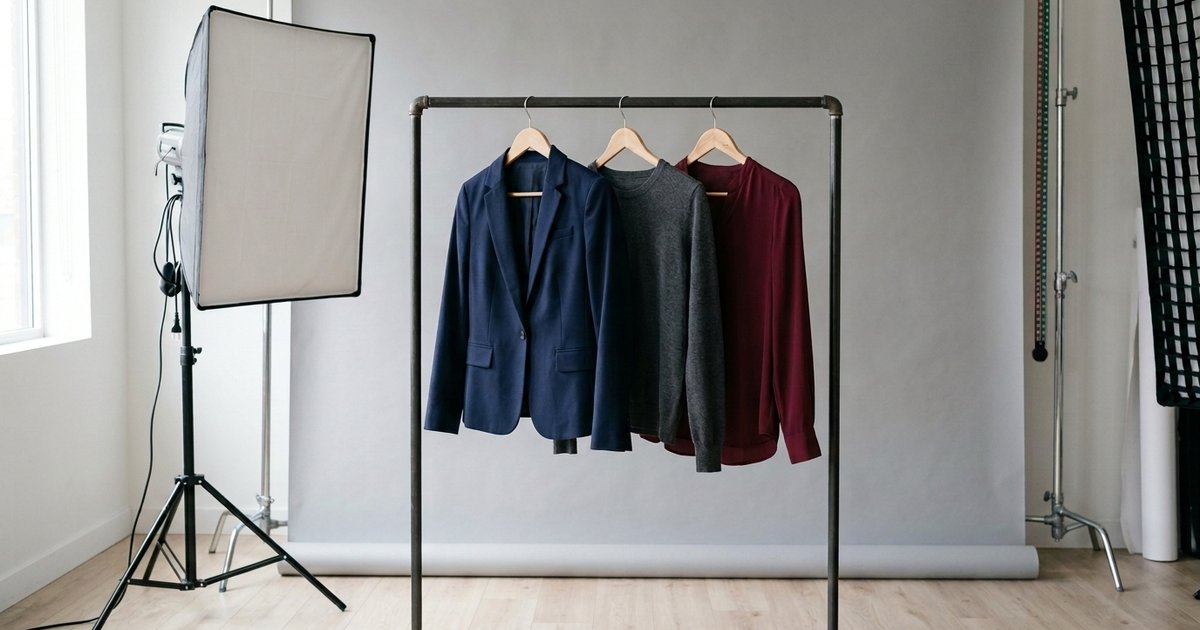
For professional headshots, wear a well-fitted top in a solid or very subtly textured fabric, in a mid-to-dark color such as navy, charcoal, burgundy or forest green, with a neckline that frames your face and minimal jewelry. Avoid neon colors, small tight patterns, shiny fabrics and large logos, and bring two or three outfits so you and the photographer can choose on the day. The rest of this guide explains why those choices work and how to adapt them to your field, your coloring and your session length.
The goal: your face should be the brightest, clearest thing in the frame
Almost every piece of headshot wardrobe advice comes back to one idea: clothing frames the face and should not compete with it. Photographer Connor Hibbs puts it as aiming for a result where "your face is the brightest and most important part of the image." In a tight crop, your clothing is only a band of color and shape across the shoulders, so small choices (a shiny fabric, a busy print, a bright collar) take up a large share of the picture.
Best colors to wear for headshots
Photographers who publish wardrobe guides recommend a similar short list:
- Navy and charcoal. Both appear at the top of most lists. They give clean contrast against most backdrops and keep attention on your face.
- Muted jewel tones. Burgundy, emerald, teal, plum and slate blue add color without shouting. Megan Murray Photography suggests thinking "burgundy instead of fire-engine red, emerald instead of neon green."
- Mid-tones. Colors that are neither very light nor very dark tend to be the most forgiving on camera.
- Warm neutrals. Camel, tan and taupe read as approachable, especially paired with a darker layer or background.
Colors to use with care
| Color | Why photographers are cautious | Safer alternative |
|---|---|---|
| Neon and fluorescent shades | They reflect light up onto the jaw and neck and are hard to correct in editing. | A muted version of the same hue |
| Bright pure white | Can blow out highlights on the collar and shoulders under studio lights. | Ivory, cream, or white layered under a dark blazer |
| Pure black | Can lose shape and merge with a dark background. | Charcoal or very dark navy |
| Colors close to your skin tone | Can make you look flat. | A shade with more contrast to your complexion |
| Trendy seasonal colors | Date the photo quickly; headshots are often used for years. | Classic neutrals or jewel tones |
Not every photographer treats white or black as off-limits. Megan Murray notes that all-white or all-black outfits "can absolutely work with the right lighting, fit, and contrast." If you love one of them, ask your photographer before the session, or add a layer or second color.
Matching color to your skin tone
A simple test from Eric Campbell Photography: hold a few tops or fabric swatches near your face in natural light and pick the one that makes your skin look most alive. Other useful clues are the color people compliment you in most often and whether you naturally gravitate toward warm colors (reds, oranges, yellows) or cool ones (blues, greens, purples). If you have had a professional color analysis, use it.
Patterns, textures and fabrics
Small, tight patterns are the most common wardrobe problem. Thin pinstripes, micro-checks, houndstooth and tiny geometric prints can create moiré, a rippling effect that shows up on camera and is difficult or impossible to remove in editing.
- Solids are the safe default. They work in every crop and on every backdrop.
- Texture, not pattern. A smooth wool or a subtle weave adds interest without distraction.
- Large, bold patterns can work. Connor Hibbs is comfortable with "large florals, thick stripes, or bold geometric shapes" because they do not cause moiré. Check with your photographer first.
- Matte fabrics photograph best. Satin, silk and shiny polyester blends can create hot spots under strobes. Matte cotton and wool blends are easier to light. To test at home, hold the garment under a bright lamp and look for reflections.
- Skip large logos and graphic tees. They pull attention to the brand instead of you.
Necklines, fit and layers
Because a headshot usually shows only the head and shoulders, the neckline and the fit across the shoulders matter more than anything below the chest.
- V-necks lengthen the neck and face and are often called the most universally flattering choice.
- Collared shirts suit corporate, legal and medical roles.
- Crew necks work well under a blazer but can look plain on their own in a tight crop.
- Turtlenecks can compress the neck; a mock neck or V-neck is a common swap.
- Fit over brand. Shoulder seams should sit at the edge of your shoulders. A quick blazer test: raise both arms. If the collar pulls away from your neck or the back rides up, the jacket is too small.
- Layers multiply looks. One blazer worn over two different tops, plus each top on its own, gives you several distinct images from a short session.
Accessories, glasses and grooming
- Jewelry: keep it minimal and matte. Small studs and a simple watch are safe; dangling earrings, chunky necklaces and statement bracelets tend to distract.
- Glasses: if you wear them every day, wear them in your headshot so people recognize you. Anti-reflective lenses reduce glare; mention your glasses to the photographer so they can adjust the lights.
- Intentional color: if you want a pop of color, put it in one place, such as a tie, scarf, blazer or lipstick, rather than in several.
- Rest: tired eyes and dark circles are hard to retouch naturally, so a good night's sleep is part of your preparation.
What to wear by industry
A useful rule is to dress one step more polished than you do on a normal workday, in a way your clients would recognize.
| Field | Typical choice |
|---|---|
| Corporate, law, finance | Tailored blazer in a darker neutral such as navy or charcoal, with a collared shirt or simple top |
| Medical | Collared shirt or blouse in a muted color |
| Tech and startups | A structured sweater or similar smart-casual layer; avoid hoodies and graphic tees |
| Personal brand and social profiles | A bolder color can help you stand out in a feed of thumbnails |
| Creative fields | More room for rich color and texture, as long as it does not overpower the face |
If your company has brand colors, use them as an accent or choose a complementary shade rather than wearing them head to toe.
How many outfits to bring
Bring more than one option. What looks good in the mirror does not always look best on camera, and many photographers say the outfit a client almost left at home ends up being the favorite.
- Short session (about 30 minutes): two or three outfits.
- Longer session (about 60 minutes): four or five looks, for example one formal, one business casual and one or two that fit your field.
- A simple mix: something light, something dark and one color you love.
Prep checklist for the day before
- Wash everything and check for stains, loose threads and missing buttons.
- Steam or iron the night before, then hang each outfit. Do not fold them for the trip.
- Pack outfits on hangers in a garment bag.
- Bring a lint roller and, if you have one, a small travel steamer.
- Check that light-colored tops are opaque and undergarments do not show through.
- Get a full night of sleep.
When you arrive, lay your options out for the photographer. They can see how each one reads against the backdrop and lighting and help you choose the order to shoot them in.


